Please Stop Ordering TCM Like It’s a Combo Meal
TCM Is Medical Care
Welcome to the Fire Horse year. A year of boldness. A year of heat. A year when the Heart sound is laughter.
And if you’ve been calling our clinic lately saying things like,
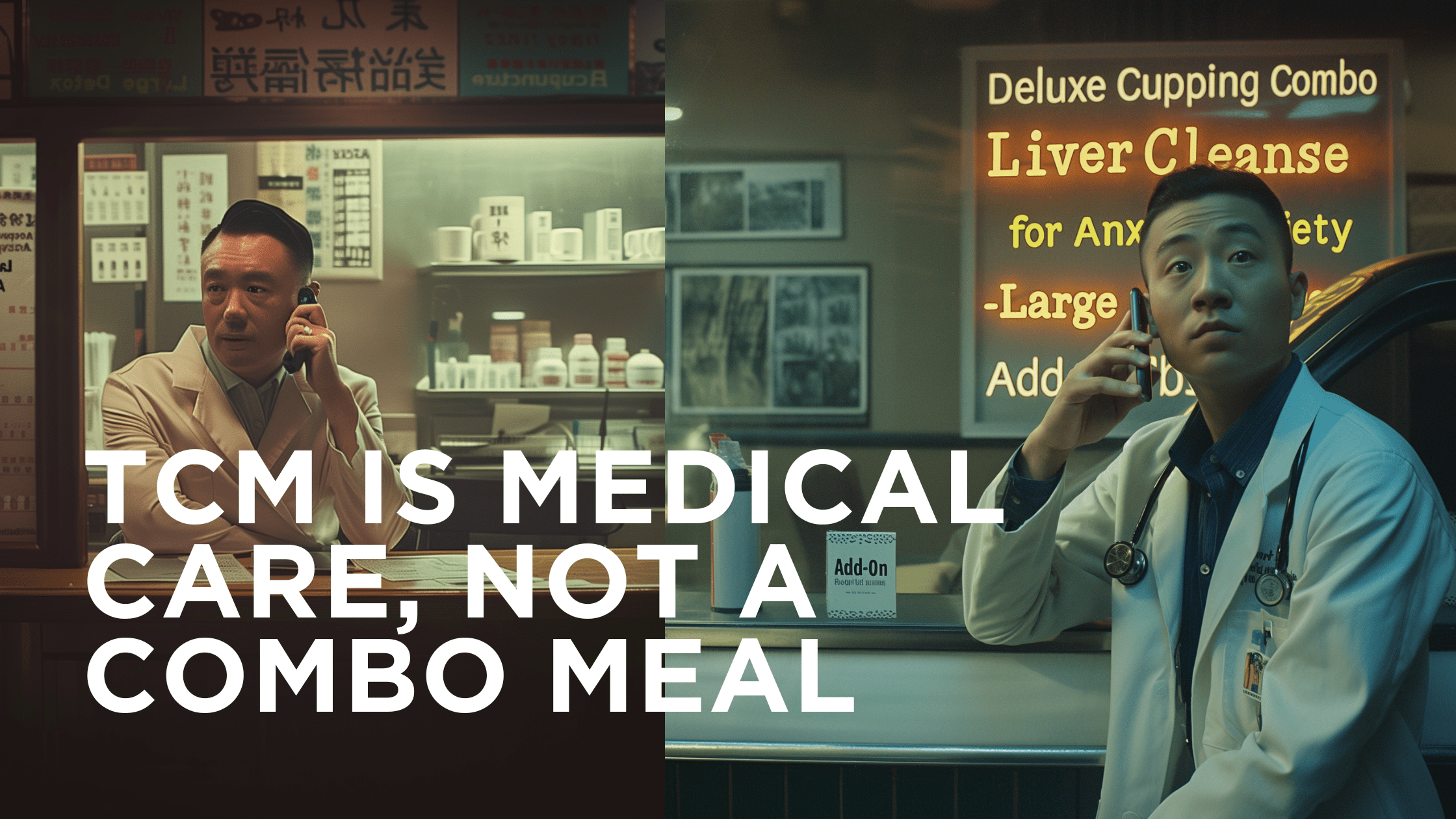
“Hi, I’d like three cupping sessions, a liver cleanse, and some acupuncture for anxiety,”
then yes…
We are laughing.
Lovingly.
Not because your symptoms aren’t real. Not because you’re wrong for wanting relief. But because somewhere along the way, Chinese medicine got mistaken for a customizable spa menu.
It is not.
Ancient Chinese medicine is not a build-your-own wellness bowl.
It is not Chipotle for your chakras.
And it is not the kind of place where you can walk in, point at a list of therapies, and say, “I’ll take two of those, hold the questions.”
It is medicine.
Structured. Procedural. Diagnostic. Intellectual. Clinical medicine.
And just like you would never walk into an ER and shout,
“One appendectomy, medium rare, and make it quick!”
—you also don’t call a Doctor of Chinese Medicine and place a therapeutic order like you’re booking a hot stone massage.
Let’s talk about why.
Step One: Medicine Has Steps. All Medicine.
There is a universal medical order of operations:
- Examination
- Diagnosis
- Treatment Plan
- Treatment
- Reassessment
This is not controversial. This is not cultural. This is not Eastern versus Western.
This is Medicine 101.
If you walk into a Western ER and declare, “I have kidney failure, please prep dialysis,” they will not clap for your initiative. They will examine you.
If you request a CT scan because you “just have a feeling,” they will evaluate whether it is indicated.
Because doctors diagnose.
Patients report symptoms.
There is a difference.
Ancient Chinese medicine has followed this structure for over two thousand years. The Huangdi Neijing (Yellow Emperor’s Classic) did not say, “Let the patient pick what feels cute today.”
It laid out detailed systems of:
- Pulse diagnosis (28+ qualities)
- Tongue diagnosis
- Channel assessment
- Pattern differentiation
- Constitutional analysis
- Organ system relationships
- Five Element theory
- Eight Principles
- Six Stages
- Four Levels
- San Jiao differentiation
In other words: this is not aromatherapy roulette.
This is a clinical system with steps, logic, and strategy.
“But I Just Want Cupping.”
Ah. Yes.
Cupping.
The darling of Instagram. The polka dots of wellness. The “I went to a practitioner” souvenir.
We love cupping. It is a brilliant therapy.
But here’s the question:
Why?
Cupping is not a lifestyle accessory. It is a technique used for specific patterns:
- Blood stasis
- Qi stagnation
- External wind-cold invasion
- Certain types of pain
- Some respiratory patterns
If you call and say, “I’d like cupping for my stress,” that tells us something.
It tells us you have selected a tool before identifying the pattern.
That’s like saying, “I’d like insulin,” without checking blood sugar.
Or, “I’ll take a cast,” before confirming there’s a fracture.
In Chinese medicine, stress is not a diagnosis. It may correspond to:
- Liver qi stagnation
- Heart yin deficiency
- Spleen qi deficiency
- Kidney yang deficiency
- Phlegm misting the mind
- Or a combination of the above
Each requires a different approach.
Some need acupuncture.
Some need herbs.
Some need dietary therapy.
Some need moxibustion.
Some need lifestyle restructuring.
Some need referral to another provider.
The treatment follows the pattern.
Not the trend.
The Menu Illusion
Somehow, along the way, Chinese medicine got marketed like this:
- Acupuncture — $X
- Cupping — $X
- Gua sha — $X
- Herbs — $X
- Facial rejuvenation — $X
And while we understand the need for clarity in services, what accidentally happened was this:
Medicine began to look like a tasting menu.
But here’s the reality:
You are not ordering therapies.
You are seeking medical care.
In a proper clinical setting, you don’t decide:
- Which channel gets needled
- Which points are used
- Which herbs are prescribed
- Whether moxa is indicated
- Whether your constitution can tolerate dispersing techniques
- Whether your presentation is excess, deficiency, hot, cold, internal, external
You describe what is happening.
The doctor determines why.
Then the doctor determines what to do.
This is not ego. It is structure.
And honestly—this is a relief. Because if patients had to diagnose themselves accurately, the ER would be filled with people requesting MRIs for “bad vibes.”
A Quick Reality Check: The “Acupuncture for Everything” Assumption
Here’s another classic:
Patient: “I have muscle pain.”
Also patient: “So… acupuncture.”
Maybe. Acupuncture is excellent for circulation, pain modulation, and reducing inflammation.
But sometimes muscle pain is not primarily a qi issue. Sometimes it’s structural alignment.
If the pelvis is rotated, if a rib is restricted, if an old injury changed mechanics, then the best first step might be Zheng Gu / Tui Na / An Mo—hands-on structural and orthopedic work that corrects alignment and releases restriction.
Sometimes we pair that with moving cupping, topical herbal applications (like Revive Cream), and then acupuncture after the structure is cooperating.
Translation: it’s not “one size fits all.”
It’s not even “one size fits most.”
It’s “we diagnose you, then we choose what works.”
Let’s Try the Reverse Scenario
Imagine walking into a Western emergency room like this:
“Hi. I’ve pre-diagnosed myself with gallbladder dysfunction. I’d like laparoscopic surgery. Also, prescribe me opioids—brand name only—and schedule physical therapy. And I prefer Dr. Smith to be my attending.”
You would be escorted out.
Politely. Or not politely.
Because medicine does not work that way.
And yet, Chinese medicine doctors regularly receive calls like:
- “I need acupuncture for migraines.”
- “I want herbs for hormones.”
- “I need cupping for my back.”
- “Can you needle just my shoulder?”
- “I don’t want any points below the knee.”
Let’s pause.
When you call a physician—Eastern or Western—you are consulting a professional trained in diagnosis.
Both systems require doctoral-level education. Both require national board exams. Both require licensure. Both involve malpractice coverage, clinical hours, and ongoing continuing education.
The medicine may differ.
The professionalism does not.
Fire Horse Energy and the Laughing Heart
Now, back to our Fire Horse year—because yes, we promised we’d keep it fun.
The Heart sound is laughter. Joy. Warmth. Connection.
But every Heart needs boundaries.
In Chinese medicine, the Pericardium guards the Heart. If the Heart is laughter, the Pericardium is the part of you that lovingly says:
“Okay… but no.”
That is the vibe of this article.
If you wouldn’t dictate your cardiac catheterization plan to a cardiologist, why would you dictate acupuncture protocols to a Doctor of Chinese Medicine?
If you trust Western diagnostics to determine treatment, why assume Eastern medicine is improvisational?
Ancient Chinese physicians were scholars. Mathematicians. Philosophers. Clinical observers. Researchers of their time.
They mapped the body in energetic networks long before imaging technology existed.
They documented case studies in detail.
They differentiated patterns with extraordinary nuance.
This was not guesswork.
It was and is method.
“But I Googled It.”
Of course you did.
We are not offended by Google.
We are mildly concerned by Google’s confidence.
There is a difference.
Reading about Liver qi stagnation does not mean you have it.
Reading about adrenal fatigue does not make it a diagnosis.
Reading that ginger is warming does not mean you should consume it daily in July while experiencing night sweats.
Chinese medicine is contextual.
Everything depends on:
- Your pulse
- Your tongue
- Your constitution
- Your climate
- Your age
- Your digestion
- Your sleep
- Your menstrual history
- Your stress patterns
- Your medical history
- Your medications
One herb can heal one person and worsen another.
One point can tonify one constitution and drain another.
This is not DIY.
And it is definitely not “TikTok Traditional Medicine University, School of Confident Guessing.”
Professional Etiquette Is Universal
Let’s talk etiquette.
When you visit any physician, the structure is simple:
- You describe symptoms.
- You answer questions.
- You allow examination.
- You receive a diagnosis.
- You discuss treatment options.
- You consent.
What you do not do:
- Override clinical reasoning
- Insist on specific tools
- Bargain for procedures
- Pre-write prescriptions
- Dictate methodology
Because when patients try to become the doctor, two things happen:
Responsibility becomes blurred.
Outcomes become compromised.
Chinese medicine requires cooperation.
It is relational.
It is responsive.
It evolves session to session.
If we treat your migraine with a dispersing Liver protocol today, and next week your presentation shifts to deficiency, we adjust.
You do not get the same “package” every time.
This is medicine.
Not choreography.
Why This Matters
You might wonder why we care.
After all, couldn’t we just nod, smile, and give you what you ask for?
Technically, yes.
But ethically? No.
If someone calls and says, “I need herbs for my thyroid,” and we have not assessed:
- Whether this is hypothyroid or hyperthyroid
- Whether it is primary or secondary
- Whether there is autoimmune involvement
- Whether medications are already being taken
- Whether the pattern is cold or heat
- Whether digestion can process herbs
- Whether there are contraindications
Then prescribing blindly would be irresponsible.
Chinese herbal medicine is pharmacologically active.
Acupuncture shifts physiology.
Cupping moves blood.
Moxibustion changes temperature regulation.
These are not scented candles.
They alter systems.
And altering systems requires diagnosis.
The Clinical Depth You Don’t See
When you lie on the table, relaxed, perhaps with soft music playing, it can feel simple.
Needles go in. You rest. You leave.
But behind that simplicity is rapid clinical processing:
- Pulse differentiation
- Organ relationships
- Element interactions
- Channel pathways
- Constitutional layering
- Root versus branch analysis
- Acute versus chronic strategy
We are constantly asking:
- Is this the root?
- Is this the branch?
- Do we treat the symptom first?
- Or the underlying imbalance?
- Is this excess masking deficiency?
- Is this heat from stagnation or deficiency?
- Is this true cold or false cold?
It is dynamic reasoning.
It is not random.
Respect Across Medical Systems
This is not East versus West.
This is not superiority.
This is parity.
We hold deep respect for our colleagues in Western medicine.
We refer to them when appropriate.
We collaborate when necessary.
We understand lab values. Imaging reports. Pharmacology interactions.
And we ask for the same professional respect in return.
Chinese medicine is not “alternative.”
It is traditional.
It is complete.
It is internally consistent.
It has its own diagnostics, pathology models, and treatment frameworks.
It deserves to be approached as medicine.
Not as an accessory.
The Satirical Truth
Let us paint a final image.
You walk into a Michelin-star French restaurant.
You wave away the chef.
“I’ll just head to the kitchen and assemble something. I’ve seen cooking shows.”
The staff would gently escort you back to your seat.
Not because you are unwelcome.
But because roles matter.
In medicine, roles matter too.
The patient’s role is powerful:
- To observe
- To report
- To ask questions
- To consent
- To participate in lifestyle change
The doctor’s role is equally powerful:
- To evaluate
- To diagnose
- To determine strategy
- To apply appropriate technique
- To reassess and modify
When these roles are respected, outcomes improve.
When they blur, confusion follows.
Humor Aside, Here Is the Invitation
In this Fire Horse year, let us laugh.
Let us enjoy the Heart’s joy.
But let us also honor boundaries.
When you call our clinic:
Say, “I’m experiencing this.”
Not, “I’d like this therapy.”
Allow us to examine you.
Allow us to diagnose you.
Allow us to recommend what your body actually needs—not what social media suggested.
Because the most powerful thing about Chinese medicine is not the needles.
It is the thinking.
The differentiation.
The precision.
The customization.
And yes, sometimes the gentle sarcasm that protects the integrity of the medicine.
With great clinical affection,
Affordable Asian Medicine
Who absolutely will not serve surgery with a side of opiates and a cupping garnish on demand—
but will happily, professionally, thoroughly diagnose you first.